Specialized Implant Solutions
LOCATOR Implant Dentures in Aliso Viejo | Snap-On & Fixed
Snap-on LOCATOR overdentures and fixed LOCATOR prostheses on 2-4 implants. Stable chewing, an open palate, and no adhesive. Many patients can upgrade removable to fixed.

Enjoy the Foods You Love & Smile Without Worry
Traditional dentures rest directly on gum tissue, relying solely on natural suction or messy adhesives to stay in place. This frequently leads to embarrassing slippage, painful sore spots, and difficulty speaking or chewing.
A LOCATOR overdenture offers a life-changing alternative. Your denture base locks onto titanium implant posts through specialised mechanical connectors, so it stays put until you choose to take it out — and the same attachments can later carry a fixed prosthesis instead.
Open Palate Design
Taste food and feel temperatures naturally.
Lock-Tight Retention
Adjustable snap retention to fit your comfort.
Perfect Stability
Speak, laugh, and dine confidently without slips.
Restored Chewing Force
Eat steak, apples, and crusty breads with ease.
Preserves Jawbone
Implant studs stimulate bone structure, preventing collapse.
Why implants matter
A denture alone does not stop the jaw from shrinking
Tooth roots do more than hold teeth. Every time you chew, they transmit load into the jawbone, and that load is the signal telling your body to keep the bone dense. Remove the roots and the signal stops.

The clinical term
Resorption
The gradual loss of jawbone volume after teeth are removed. It is fastest in the first year and continues for as long as the bone goes unloaded.
A conventional denture rests on the gums
It transmits almost nothing into the bone underneath, so resorption continues while you wear it. That is why a denture that fit well two years ago rocks today.
Shrinking bone changes your face
As the ridge flattens, the lower third of the face loses height. The chin rotates forward, lip support falls away, and folds deepen around the mouth.
Implants restore the load path
An implant integrates with bone and carries chewing force into it again. That is the difference between replacing teeth and replacing what teeth were doing.
Which Solution is Right for You?
Evaluate how Locator Snap-On Dentures balance stability, comfort, and cost compared to traditional plates and All-on-4 fixed hybrid bridges.
| Feature / Detail | Traditional Dentures | Locator Snap-On Dentures | All-on-4 Fixed Bridges |
|---|---|---|---|
| Stability & Security | Poor (slips, clicks, floats on gums) | High (securely locked, no slippage) | Absolute (completely fixed, non-removable) |
| Chewing Power | Very Low (approx. 15% of natural strength) | Strong (approx. 60-70% of natural strength) | Full (approx. 90-100% of natural strength) |
| Palate Coverage | Bulky acrylic roof-of-mouth cover | Open Palate (tastes food naturally) | Open Palate (completely natural feel) |
| Adhesive Needed? | Yes (requires messy creams daily) | No (locks mechanically) | No (permanently screwed) |
| Cleaning & Hygiene | Must remove to soak | Snaps out easily for simple brushing | Brushed in place like natural teeth |
| Relative Cost | Economical / Budget | Moderate (great value balance) | Premium |
Two LOCATOR options
Removable, fixed, or start removable and upgrade later
LOCATOR is an attachment system, not a single treatment. The same implants and the same attachments support two different prostheses — which is what makes it possible to start with one and move to the other.

Conventional denture
No implants
Rests on the gums and is held by suction and adhesive. The most affordable option, and the only one that does nothing to slow bone loss.
You remove it
LOCATOR overdenture
Implant-retained · removable
Snaps onto LOCATOR attachments on 2–4 implants. It locks down for eating and speaking, and you take it out at night to clean it and the attachments underneath.
You remove it
LOCATOR FIXED
Implant-supported · fixed
A prosthesis that seats on the same LOCATOR abutments but stays in. You clean around it like natural teeth; only the dentist removes it, at recall visits.
Only the dentist removes it
"Retained" and "supported" are not marketing words — they describe who can take the prosthesis out. That single difference drives cleaning, cost, and how the bite feels.

Clinical Precision, Absolute Fit
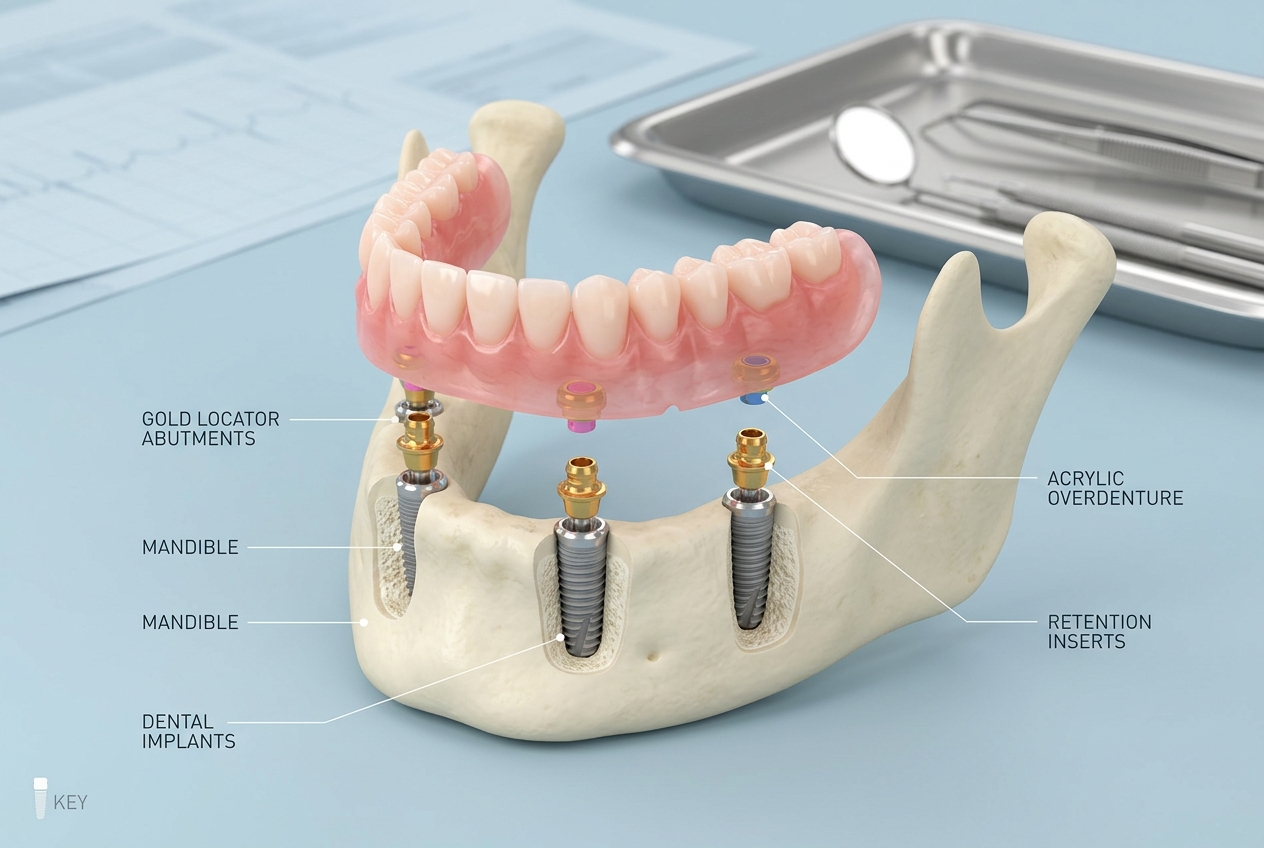
The Locator system relies on a mechanical snap connection. We place 2 to 4 titanium implants in your jawbone, topped with medical-grade gold-colored Locator studs.
Titanium Implant Studs
Placed directly into the bone for maximum anchor stability.
Gold-Colored Locator Abutments
The connectors that protrude slightly above the gums.
Custom Retention Inserts
Color-coded plastic inserts inside the denture that calibrate the tightness.
Already wearing a snap-on denture?
Many patients can convert to fixed without new implants
This is the part most people do not know. If you already wear a LOCATOR overdenture, the implants and abutments doing the work are the same ones a fixed prosthesis seats on. In many cases the upgrade is a prosthetic step, not a surgical one.
For patients who already have at least four healthy, well-positioned implants in the arch. A 3D scan confirms implant number, angulation, and the restorative space available before anything is promised.

- 1
We scan what you already have
A CBCT and a digital scan tell us how many implants you have, how they are angled, and whether there is enough vertical space for a fixed prosthesis.
- 2
We check the existing attachments
LOCATOR abutments that are sound and correctly positioned can often be reused. Where they cannot, replacing an abutment is far less involved than placing an implant.
- 3
We make the fixed prosthesis
Designed and milled in our in-house lab, then seated and torqued. You leave with teeth that stay in.
If you have fewer than four implants
A fixed conversion is still often possible — it usually means adding implants first. That is a surgical step with its own healing time, and we will say so plainly rather than describing it as a simple upgrade.
See our in-house labCandidacy
Who this works for, and who needs a longer conversation
Most people missing a full arch are candidates for something on this page. The honest answer to which option depends on bone, medical history, and what you want your daily routine to look like.
A good fit if you
- Are missing all or most teeth in an arch
- Are tired of adhesive, slipping, or a denture that clicks
- Want to taste food again without a plastic palate
- Have enough bone, or are open to grafting to build it
- Already have implants and want more from them
Needs evaluation first
- Heavy smoking — it measurably lowers implant success
- Diabetes that is not yet under control
- Certain blood and clotting disorders
- IV bisphosphonates for osteoporosis or bone cancer
- Previous radiation therapy to the head or neck
None of these is an automatic no. They mean we coordinate with your physician and plan differently — and that we tell you the real risk rather than booking surgery and hoping.
Upper and lower arches are not the same job
Lower arch
Often 2 implantsThe lower jaw is denser and a lower denture is the one that floats most, so the gain in stability is dramatic. Two implants transform it; four make it better still.
Upper arch
Typically 4 implantsUpper bone is softer and the sinuses limit height, so we spread the load across more implants. The payoff is removing the palate — the single change most patients notice at the first meal.
The Snap-On Denture Process
From diagnostic 3D imaging to final custom fitting, we manage your treatment comfortably and entirely in-house.
Diagnostic 3D CBCT
We scan your bone structure in 3D using our Carestream system to identify placement coordinates with safety.
Gentle Implant Surgery
We place 2 to 4 implants under local anesthesia or sedation, allowing 3-4 months to integrate with the bone.
Stud & Cap Fitting
We attach Locator abutments, take detailed digital impressions, and embed locking inserts in the denture.
Delivery & Balancing
We deliver your custom-shaded overdenture, snap it into place, and balance the bite to perfection.
Cost & financing
What actually drives the price
We do not publish a single number, because the same treatment name can differ by thousands depending on the five things below. You get a written figure after your 3D scan — before you commit to anything.
How many implants the arch needs
Two versus four is the single biggest line item, and it is decided by your bone, not by a package price.
Whether you already have implants
Reusing sound implants and abutments removes the largest surgical cost from the estimate entirely.
Removable or fixed
A fixed prosthesis costs more than a removable overdenture — more material, more lab time, more precision at the seat.
Whether grafting is needed
If the ridge has resorbed past what an implant can hold, building it back is a separate procedure with its own timeline.
Material of the final prosthesis
Acrylic, reinforced acrylic, and zirconia sit at different price points and last different lengths of time.
Insurance and payment
Many PPO plans cover part of a denture and sometimes part of the implant surgery, and the two are often billed separately. We verify your benefits before treatment and offer financing through CareCredit and Cherry for the balance.
Insurance & financing optionsLiving with them
What maintenance actually looks like
Both options need upkeep, and the upkeep is different. Knowing which routine you are signing up for matters more than most people expect.
Removable LOCATOR overdenture
- Take it out nightly; brush it with non-abrasive denture cleaner
- Brush the abutments in your mouth with a soft brush daily
- Replace the nylon retention inserts every 12–18 months — a five-minute chairside visit
- Expect a reline as the ridge continues to change shape
Fixed LOCATOR prosthesis
- Brush and clean around it like natural teeth, every day
- A water flosser and interdental brushes do the work floss cannot
- Removed and professionally cleaned at recall, typically once a year
- No nightly removal, and no inserts to wear out
How long do they last?
Implants that integrate well and are kept clean commonly last decades. The prosthesis on top is the part that wears — acrylic teeth abrade, and a denture base eventually needs relining or remaking. Plan on maintaining the prosthesis, not replacing the implants.
Snap-On Overdentures vs. All-on-4®
Weighing a removable LOCATOR overdenture against a fixed All-on-4 bridge? Our comparison guide walks through surgery, cost, cleaning, and how each one feels day to day.
Not sure a LOCATOR solution is the right fit?
See the full range of implant-supported denture designs — including standard removable overdentures — to compare stability, cost, and maintenance.
Compare
Other full-arch options we place
Frequently Asked Questions
Confidence, Secured
A denture that stays put changes meals, conversations, and photographs.
*Stock model photography for illustrative purposes only. Individual results may vary.
Experience True Chewing Stability
Schedule your free implant evaluation in Aliso Viejo today.
Patient education
Keep your smile moving forward
Read practical treatment guides and oral-health answers from the AVF Dental Group team.

Zirconia Crown: Advantages and Disadvantages of Zirconia Crown
Is zirconia better than porcelain? How long do zirconia crowns last? A complete look at the strongest dental crown material available today.
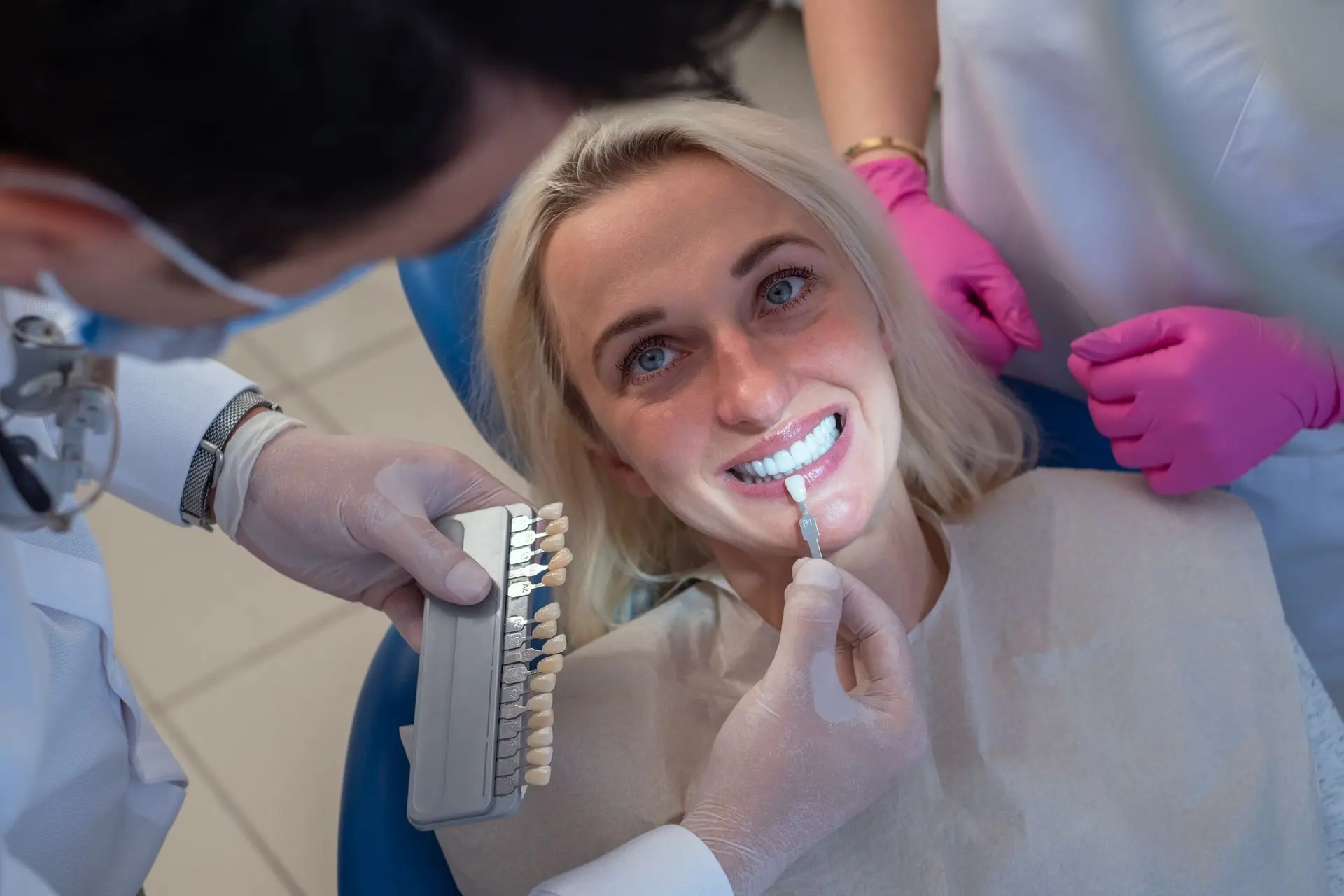
Dental Veneers: Pros and Cons of Porcelain and Composite Veneers
Comparing porcelain, composite, and Lumineer veneers — advantages, disadvantages, candidacy, and cost considerations.
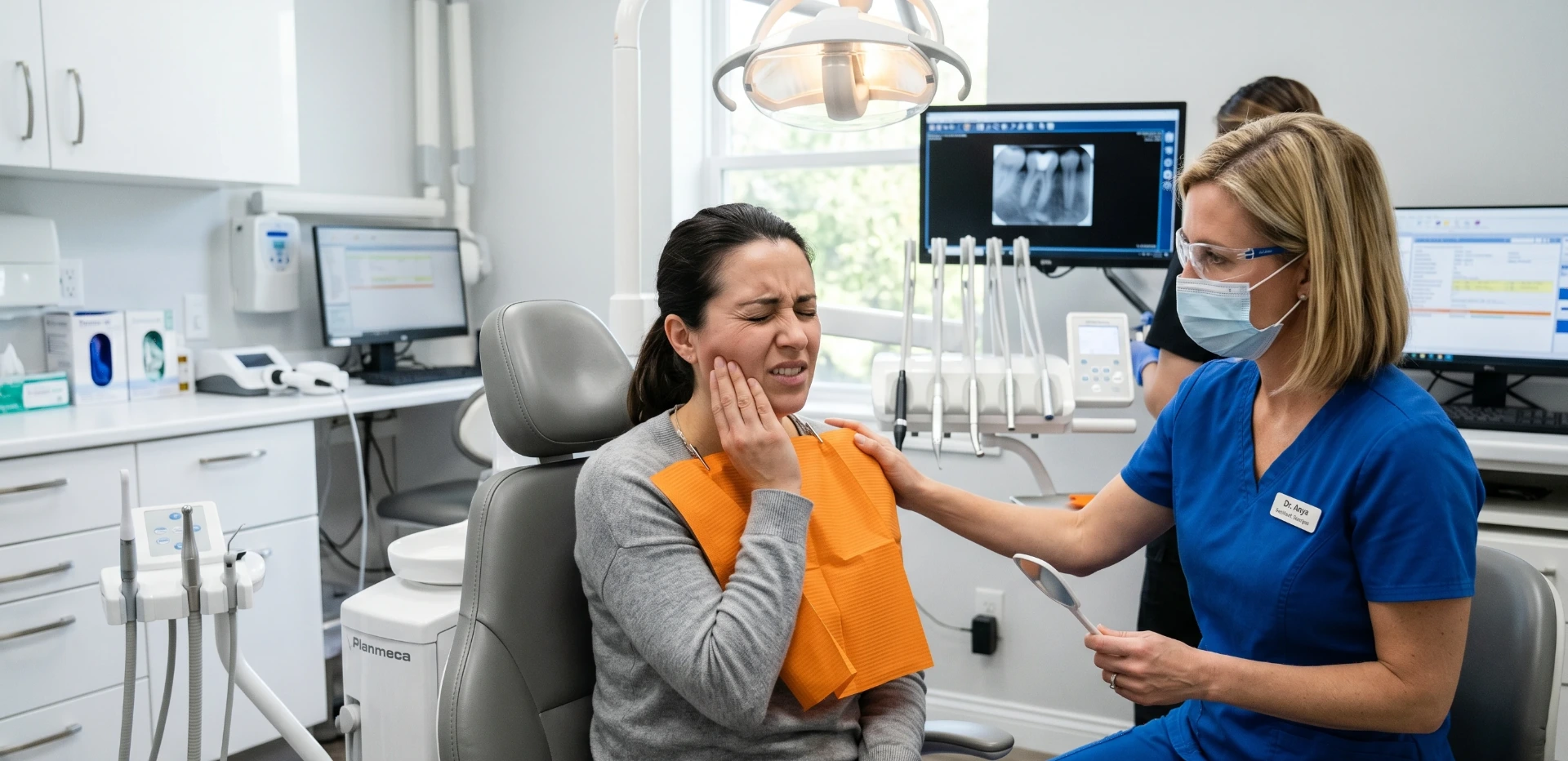
Wisdom Tooth Removal: When Is Wisdom Tooth Extraction Necessary?
Not every wisdom tooth needs to come out. Here is how dentists decide which third molars to remove and which to leave alone.