Patient Resources
Dental Glossary
Dentistry has a lot of jargon, and most of it hides a simple idea. Here is what the terms actually mean — and which treatment each one belongs to.
Implant-retained denture
A removable overdenture that snaps onto implants — you take it out yourself to clean it.
Implant-supported
Fixed. Only your dentist removes it.
Every term links to the treatment it belongs to
62 terms
- Lab & CAD/CAM
5-axis milling
A mill that moves the bur along five axes at once, so it can reach undercuts and angled surfaces a three-axis machine cannot. Required for full-arch and implant-bar work.
Learn more- Implants
Abutment
The connector that screws into the implant and sticks up through the gum. Everything you can see — a crown, a denture attachment — mounts onto the abutment, not onto the implant directly.
Learn more- Imaging
ALARA
'As Low As Reasonably Achievable' — the radiation-safety principle behind taking the smallest field of view and the lowest dose that will still answer the clinical question.
Also called: low dose protocol
Learn more- Implants
All-on-4
A fixed full-arch bridge carried by four implants, with the back two angled to avoid the sinus and nerve. Usually involves reducing the bony ridge to make room for the prosthesis.
Learn more- Implants
All-on-6
The same idea as All-on-4 with six implants instead of four, spreading chewing load further. Often chosen for heavy bites or softer upper-jaw bone.
Learn more- Implants
Bar-retained denture
An overdenture that clips onto a custom metal bar joining several implants, instead of onto individual attachments. Splinting the implants together spreads load, at the cost of a bulkier design.
Learn more- Dentures & LOCATOR
Bite registration
A record of how your upper and lower jaws meet. Without it a technician can build beautiful teeth that do not fit the way you actually close.
Also called: occlusal record
Learn more- Imaging
Bitewing X-ray
A close-up of the crowns of upper and lower back teeth in one shot. The standard way to catch decay between teeth and check bone levels at routine visits.
Learn more- Implants
Bone graft
Adding bone material to a site that has lost too much volume to hold an implant. It is a separate procedure with its own healing period before the implant can be placed.
Learn more- Dentures & LOCATOR
Bone resorption
The gradual loss of jawbone volume after teeth are removed. Tooth roots load the bone every time you chew, and that load is what keeps it dense — remove the roots and the ridge slowly flattens.
Also called: ridge resorption, jawbone shrinkage
Learn more- Restorative & Crowns
Bridge
A run of joined crowns that replaces one or more missing teeth by anchoring to the teeth or implants on either side of the gap.
Learn more- Gums & Prevention
Bruxism
Habitual grinding or clenching, usually during sleep. It flattens enamel, cracks restorations, and is the most common reason a well-made crown fails early.
Also called: teeth grinding, clenching
Learn more- Lab & CAD/CAM
CAD/CAM dentistry
Computer-aided design and manufacturing. The restoration is designed on screen from a digital scan, then cut by a milling machine — no physical model, no hand-carved wax.
Learn more- Gums & Prevention
Calculus (tartar)
Plaque that has mineralised into a hard deposit bonded to the tooth. Brushing no longer touches it — it has to be scaled off with instruments.
Also called: tartar
Learn more- Imaging
CBCT
Cone beam computed tomography — a 3D X-ray that shows bone volume, nerve position, and sinus anatomy. It is what makes implant placement a measured plan rather than an estimate.
Also called: cone beam CT, 3D dental scan
Learn more- Restorative & Crowns
Composite bonding
Sculpting tooth-coloured resin directly onto a tooth in one visit to close a gap, rebuild a chip, or reshape an edge. Reversible and the least invasive cosmetic option.
Learn more- Dentures & LOCATOR
Conventional denture
A full denture that rests on the gums, held by suction and adhesive. The most affordable replacement for a full arch, and the only option that does nothing to slow bone resorption.
Also called: traditional denture, full denture, false teeth
Learn more- Restorative & Crowns
Crown
A cap that covers the whole visible part of a tooth, restoring its shape and strength after a fracture, a large filling, or a root canal.
Also called: dental cap, tooth cap
Learn more- Implants
Dental implant
A titanium post placed into the jawbone to replace a missing tooth root. It is the anchor; the crown, bridge, or denture that attaches to it is a separate part.
Also called: tooth implant, titanium post
Learn more- Lab & CAD/CAM
Digital impression
The 3D file an intraoral scan produces. It can be stored, re-sent, and re-milled indefinitely, unlike a silicone impression that distorts and must be retaken.
Learn more- Lab & CAD/CAM
Digital wax-up
A on-screen preview of the proposed final teeth, designed before any tooth is touched. It is what lets you approve the shape and length in advance rather than after.
Also called: digital smile design, mock-up
Learn more- Imaging
Field of view
How much anatomy a 3D scan captures. A small field for a single implant keeps the dose down; a full-arch case needs a larger one.
Also called: FOV
Learn more- Dentures & LOCATOR
Flange
The lip of pink acrylic on a denture that extends over the gum ridge. It provides seal and lip support; a fixed prosthesis usually needs far less of it.
Learn more- Gums & Prevention
Gingivitis
Inflammation of the gums from plaque at the gum line — red, puffy, bleeding when brushed. It is fully reversible, which is what separates it from periodontitis.
Learn more- Lab & CAD/CAM
Glazing
The final firing that seals the surface of a ceramic restoration and sets its shine. Also where individual staining is added so the piece is not flatly uniform in colour.
Learn more- Imaging
Guided surgery
Placing implants through a custom surgical guide printed from the CBCT plan, so the drill follows the position decided on screen rather than being judged freehand.
Learn more- Gums & Prevention
Gum recession
Gum margin migrating down the root, exposing a surface that has no enamel. It causes sensitivity, is prone to decay, and does not regrow without grafting.
Learn more- Implants
Healing abutment
A temporary cap screwed onto an implant while the gum heals around it, shaping the cuff of tissue the final crown will emerge through.
Learn more- Dentures & LOCATOR
Immediate denture
A denture made in advance and fitted the same day teeth are removed, so you are never without teeth. It needs relining later as the ridge heals and reshapes.
Learn more- Implants
Immediate load
Attaching a temporary prosthesis to implants on the day they are placed, rather than waiting for osseointegration. Possible only when the implants are stable enough at placement.
Learn more- Dentures & LOCATOR
Implant-retained denture
A removable overdenture that snaps onto implants. You take it out yourself to clean it. The implants hold it down; your gums still carry much of the chewing load.
Also called: snap-on denture, snap-in denture, removable overdenture
Learn more- Dentures & LOCATOR
Implant-supported denture
A fixed prosthesis that only your dentist removes. The implants carry the chewing load rather than your gums. The word patients most often confuse with 'implant-retained' — the difference is who can take it out.
Also called: fixed denture, non-removable denture
Learn more- Restorative & Crowns
Inlay and onlay
Partial-coverage restorations bonded into a prepared tooth. An inlay sits within the cusps; an onlay also covers one or more of them. Both preserve more natural tooth than a full crown.
Learn more- Lab & CAD/CAM
Intraoral scanner
A handheld wand that photographs your teeth thousands of times a second and assembles a 3D model. It replaces impression trays and the setting paste that causes gagging.
Also called: digital scanner, 3D scanner
Learn more- Restorative & Crowns
IPS e.max
A lithium-disilicate glass-ceramic prized for scattering light the way natural enamel does. The usual choice for front teeth and veneers, where appearance matters more than raw strength.
Learn more- Dentures & LOCATOR
LOCATOR attachment
A low-profile stud-and-socket connector that screws onto an implant. A matching nylon insert in the denture clicks over it, which is where the 'snap-on' description comes from.
Learn more- Dentures & LOCATOR
LOCATOR FIXED
A fixed prosthesis that seats on the same LOCATOR abutments a removable overdenture uses. Because the attachments are shared, patients who already have four well-placed implants can often convert from removable to fixed without new surgery.
Learn more- Restorative & Crowns
Margin
The join where a restoration meets the tooth. A margin that is not sealed to within microns is where recurrent decay starts, which is why fit matters more than appearance.
Learn more- Lab & CAD/CAM
Milling
Cutting a restoration out of a solid block of ceramic with rotating burs, rather than building it up by hand. Subtractive manufacturing, which is why fit is repeatable to the micron.
Learn more- Lab & CAD/CAM
Monolithic restoration
A crown or bridge milled from one solid block rather than layered with porcelain on a substructure. Fewer interfaces means fewer places to chip.
Learn more- Implants
Osseointegration
The process by which living bone grows directly onto the surface of an implant and locks it in place. It typically takes three to four months and is why implants are not loaded immediately in most cases.
Learn more- Dentures & LOCATOR
Overdenture
A denture that sits over something holding it down — implants or retained tooth roots — rather than resting on gum alone. The umbrella term for the snap-on designs below.
Learn more- Dentures & LOCATOR
Palate coverage
The acrylic plate covering the roof of the mouth in an upper denture. It provides suction but blunts taste and triggers gagging — removing it is the change most patients notice first after implants.
Learn more- Imaging
Panoramic X-ray
A single flat image of both jaws, the sinuses, and the joints. Excellent for an overview, but it flattens depth — it cannot tell you how wide the bone is where an implant needs to go.
Also called: OPG, pano
Learn more- Implants
Peri-implantitis
Inflammation and bone loss around an implant, caused by plaque left at the gum line. It is the main reason a well-placed implant fails years later, and it is largely preventable with cleaning and recall visits.
Learn more- Imaging
Periapical X-ray
A close-up of one tooth from crown to root tip, used to look for infection at the root end. The standard image before and after a root canal.
Also called: PA
Learn more- Gums & Prevention
Periodontitis
Gum inflammation that has spread to the bone holding the teeth, and the bone has started to go. The lost bone does not grow back on its own — treatment stops the loss rather than reversing it.
Also called: gum disease
Learn more- Gums & Prevention
Plaque
The soft, sticky bacterial film that forms on teeth within hours of brushing. Everything else on this list starts here — it is the only cause you can remove yourself, daily.
Learn more- Restorative & Crowns
Pontic
The false tooth in the middle of a bridge — the part that spans the gap and touches gum without being anchored into it.
Learn more- Restorative & Crowns
Provisional restoration
A temporary crown or bridge worn while the final one is made. When a restoration is milled in-house the same day, there is no provisional stage at all.
Also called: temporary crown, temp
Learn more- Dentures & LOCATOR
Reline
Resurfacing the tissue side of a denture so it matches a ridge that has changed shape. Routine maintenance rather than a failure — the jaw keeps remodelling underneath.
Learn more- Dentures & LOCATOR
Retention insert
The colour-coded nylon ring inside a snap-on denture that grips the attachment. Different colours give different holding strength, and they wear out every 12 to 18 months — a five-minute replacement.
Learn more- Restorative & Crowns
Root canal treatment
Removing infected pulp from inside a tooth, disinfecting the canals, and sealing them. It saves the tooth; a crown afterwards is usually what keeps it from fracturing.
Also called: endodontics, RCT
Learn more- Lab & CAD/CAM
Same-day dentistry
Scanning, designing, milling, and bonding a final restoration in one appointment. It requires a lab on site — the wait in conventional treatment is shipping and queueing, not clinical time.
Also called: one-visit crown, same day crown
Learn more- Gums & Prevention
Scaling and root planing
A deep clean below the gum line that removes calculus from the root surfaces and smooths them so gum tissue can reattach. Usually done under local anaesthetic, a quadrant at a time.
Also called: deep cleaning, SRP
Learn more- Restorative & Crowns
Shade matching
Choosing the colour, translucency, and surface texture of a restoration so it disappears next to your own teeth. Best done in natural light beside the tooth itself, not from a chart alone.
Learn more- Lab & CAD/CAM
Sintering
Firing a milled zirconia restoration in a furnace so its crystals fuse and it reaches full strength. The piece shrinks by roughly 20% during firing, which the design compensates for in advance.
Learn more- Implants
Sinus lift
A graft that raises the floor of the maxillary sinus to create height for implants in the upper back jaw, where bone is often thinnest.
Learn more- Implants
Torque
The measured tightening force applied to an implant screw, in newton-centimetres. Too little and the screw loosens; too much and it fractures — which is why it is set with a calibrated wrench, not by feel.
Learn more- Lab & CAD/CAM
Try-in
Seating an unfinished prosthesis to check fit, bite, and appearance while it can still be changed. The last chance to move a tooth before the piece is finished.
Learn more- Restorative & Crowns
Veneer
A thin ceramic facing bonded to the front of a tooth to change its colour, shape, or alignment. It covers the visible surface only, unlike a crown.
Learn more- Restorative & Crowns
Zirconia
A very fracture-resistant ceramic used for back teeth, bridges, and full-arch prostheses where bite forces are highest. Stronger than glass-ceramic, slightly less translucent.
Learn more
Still Not Sure What Something Means?
Ask at your consultation. We would rather spend five minutes explaining than have you agree to something you did not follow.
Patient education
Keep your smile moving forward
Read practical treatment guides and oral-health answers from the AVF Dental Group team.

Zirconia Crown: Advantages and Disadvantages of Zirconia Crown
Is zirconia better than porcelain? How long do zirconia crowns last? A complete look at the strongest dental crown material available today.
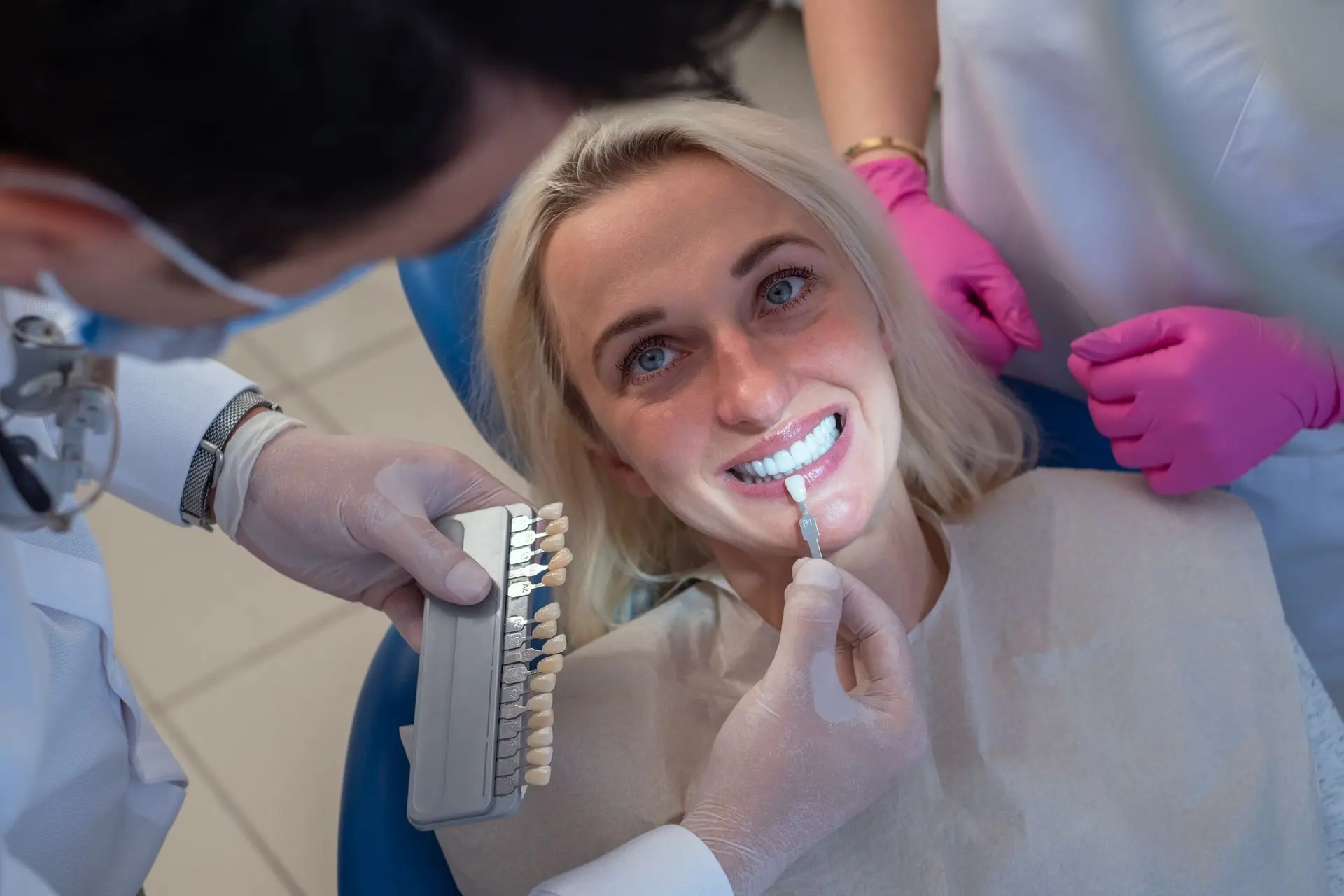
Dental Veneers: Pros and Cons of Porcelain and Composite Veneers
Comparing porcelain, composite, and Lumineer veneers — advantages, disadvantages, candidacy, and cost considerations.
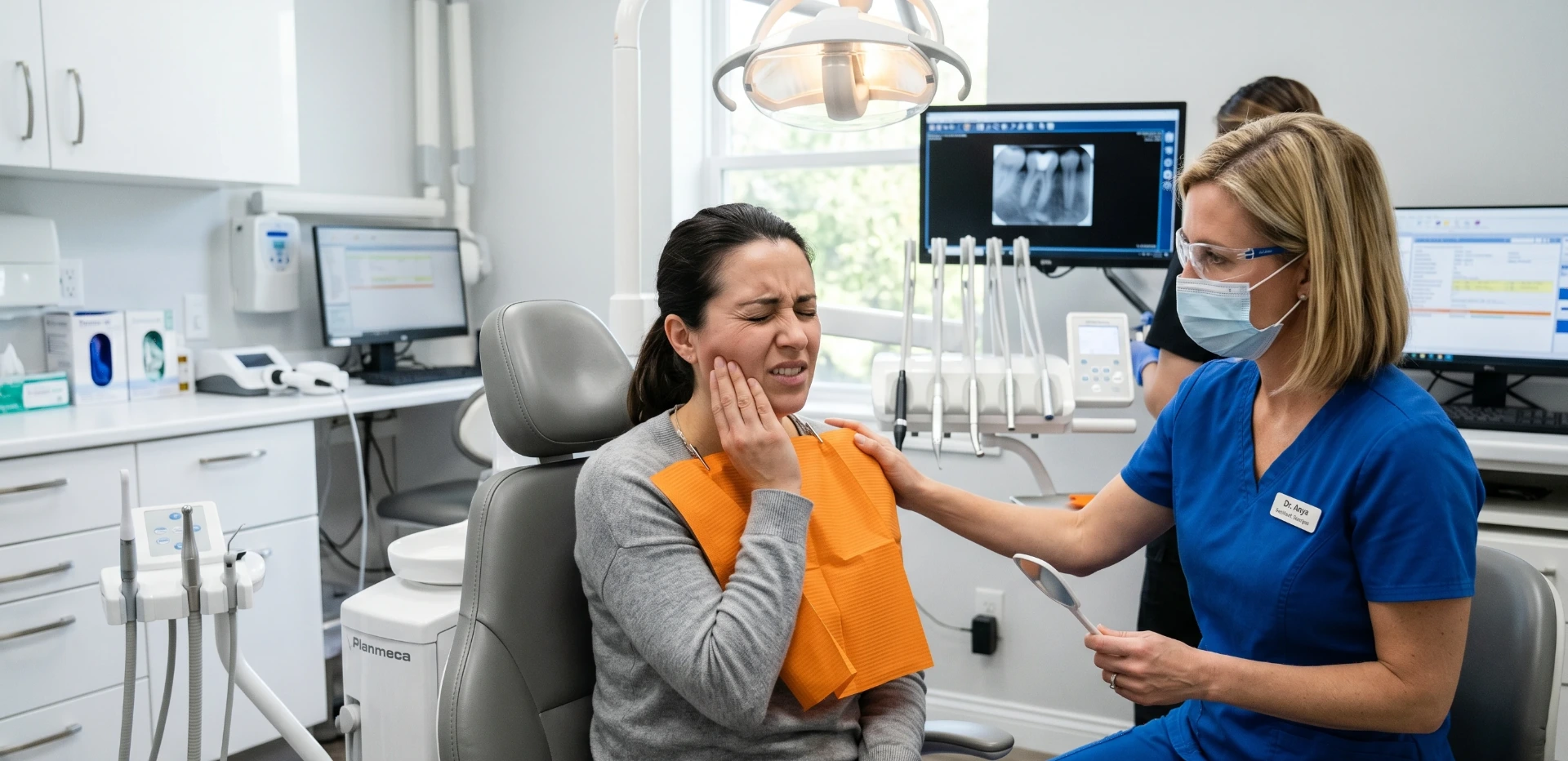
Wisdom Tooth Removal: When Is Wisdom Tooth Extraction Necessary?
Not every wisdom tooth needs to come out. Here is how dentists decide which third molars to remove and which to leave alone.